
Collecting Specimens
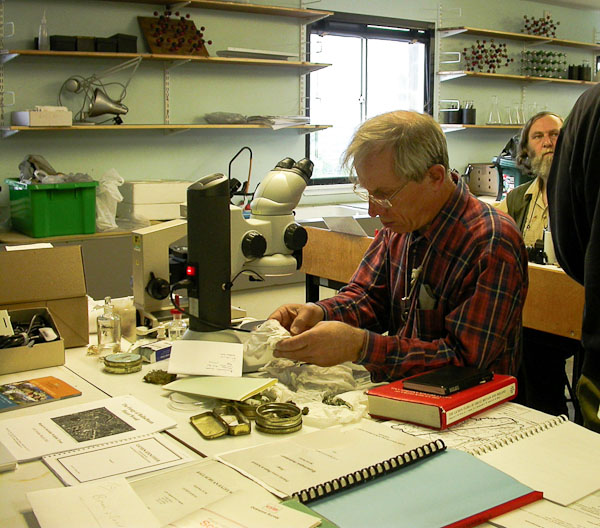 Beginners may find it useful to make a small reference collection of common species as they get to grips with them, but once that stage is past collections should only be made when needed for scientific purposes. This may be for further investigation, such as microscope work or chemical tests that can’t be carried out in the field, or to send a specimen on to a referee for confirmation. Voucher specimens should be collected for new vice county or national records.
The landowner’s permission should always be obtained before collecting, and if the site is a SSSI the permission of the national agency (CCW, NE, SNH etc) will also be required.
Never remove all material of a species on a particular substratum . By leaving plenty the species can survive. Specimens that are distorted or atypical will be almost impossible to identify, so ensure that those collected are in good condition.
If you do take a sample, either as a reference specimen or a voucher, place each in a separate paper packet (see below). If collecting in wet conditions you will find the bags provided for your convenience when travelling by air to be ideal (!) as they can be left open to allow the specimens to dry naturally. Never use polythene or plastic bags as moist specimens will deteriorate quickly. On the packet, record the site name, date, results of initial spot chemical tests and initial identification (where known). For species on bark, note the tree species; on stone note the rock type; on earth or moss, note whether the location is sheltered, shaded or humid.
As an alternative to paper packets, small cardboard containers, plastic compartmentalized boxes (e.g. one made for DIY or fishing tackle) or tins are useful for delicate species such as pin-head lichens provided they are dry. Include a slip of paper describing the precise location and grid reference (the GPS reading is ideal).
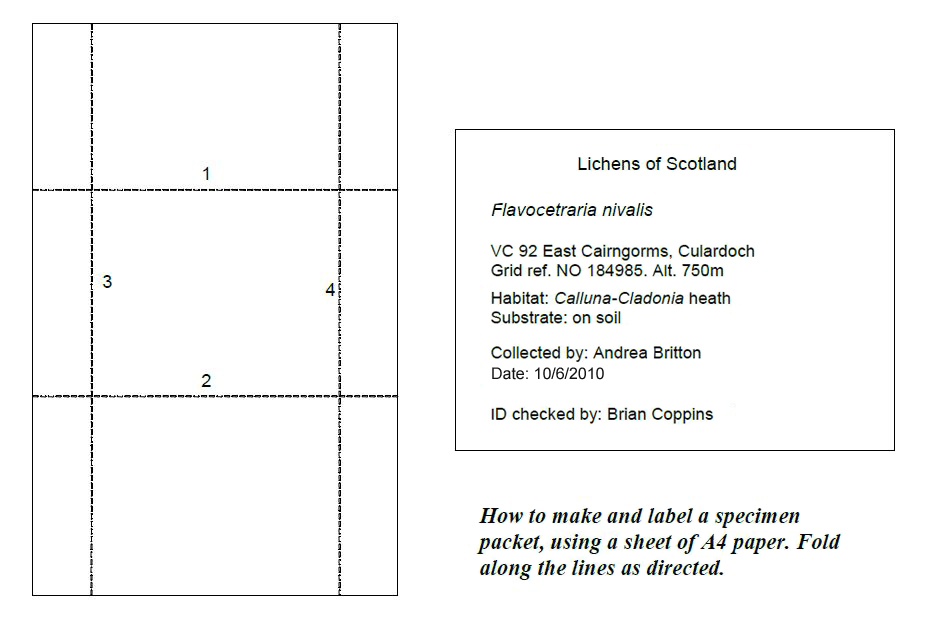
When taking a sample, select a representative part of a thallus which has:
-
a good edge (foliose and crustose species);
-
a holdfast or basal parts and branch ends in fruticose species such as Bryoria and Usnea;
-
examples of mature spore-producing bodies (ascomata);
-
asexual propagules such as soredia or isidia;
-
a sufficient quantity of material for chemical tests
Leave each packet or other container open to dry; damp lichens go mouldy and are of no use. Specimens should not be dried on hot radiators or in ovens as this may make them unsuitable for molecular studies by specialists.
Once dry, seal the packets in a plastic bag and place in a freezer for two days to kill off invertebrates, such as mites, which are likely to make a meal of your samples. (A domestic freezer is adequate for the purpose.) Freezing is also recommended if it is likely that molecular work may be undertaken – not necessarily by yourself, but perhaps by a referee to whom it is referred. Make sure that the packets don’t re-acquire moisture by condensation when you take them out of the freezer.